Reading Brain Boost

Discover how daily reading reshapes brain chemistry, enhances empathy, memory, and focus. Explore practical tips to make reading a lasting habit.

An elegant close-up of an open paperback book, its crisp off-white pages curving into a gentle arc, with individual lines of text razor-sharp in the foreground. Behind the book, a semi-transparent digital overlay of a brain formed from softly glowing blue and gold neural networks appears to float, perfectly aligned with the spine. The background is a dark, velvety blur of bookshelves, suggesting a library. Dramatic side lighting from the left creates subtle shadows between the pages and a luminous halo around the neural brain. Photographic realism with a cinematic, slightly low-angle composition, creating a sense of depth and wonder. The mood is thoughtful and scientific, illustrating how reading activates complex brain circuitry in a visually compelling way.

Study Insights

A cozy reading nook captured in photographic realism: a well-worn leather armchair suggested only by its curved arm and textured surface, with a small stack of diverse books resting on a side table. Above the table, faintly superimposed in the air, a translucent illustration of neurotransmitter molecules and serotonin pathways glows in soft teal and amber tones, as if emanating from the books themselves. Warm golden-hour light pours in from the right, illuminating dust motes and drawing a gentle highlight along the book edges while the background dissolves into a soft bokeh of shelves and fabric textures. Shot from a slightly elevated angle using the rule of thirds, the mood is comforting yet intellectually stimulating, showing how reading can literally change mood and brain chemistry.
An ultra-detailed macro photographic image of a single open book page, the paper fibers subtly visible, with the printed text fading into a fantastical overlay of branching neural pathways. The ink near the center of the page slowly transforms into luminous, thread-like axons and synapses extending outward, glowing in electric blues and soft purples. The background dissolves into a velvety dark blur, isolating the page and neural web. A narrow beam of spotlight-style lighting from above highlights the transformation zone, casting delicate shadows in the tiny paper texture. The mood is intimate, mysterious, and scientifically inspired, emphasizing at a microscopic level how the act of reading can rewrite neural connections and alter brain chemistry and structure.
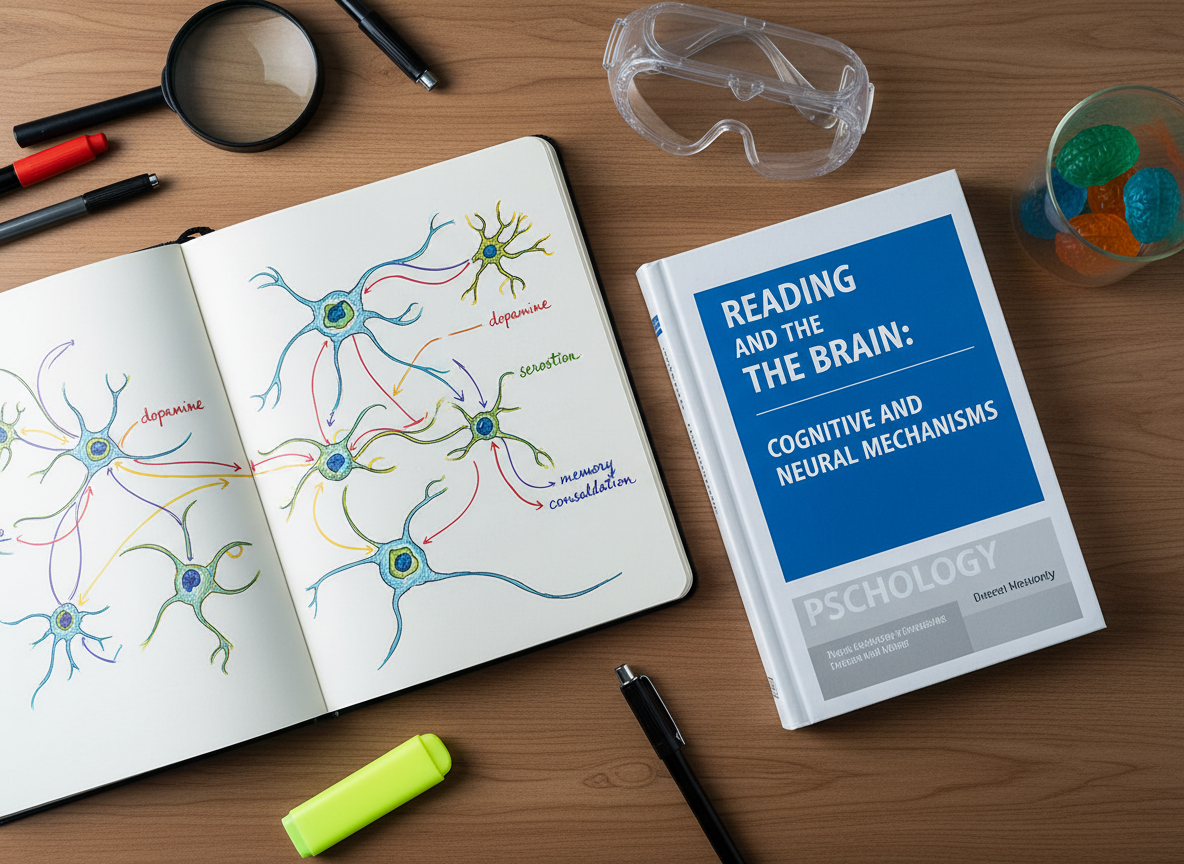
A close, top-down photographic shot of a wooden desk where an open science notebook lies beside a thick psychology textbook about reading and the brain. Detailed hand-drawn diagrams of neurons and synapses fill the notebook page, with colored inks tracing pathways labeled “dopamine,” “serotonin,” and “memory consolidation.” A pair of transparent safety goggles and a small glass beaker containing colorful brain-shaped gel models sit nearby, hinting at experimentation without showing any person. Cool, diffused lab lighting from above creates soft, even illumination and gentle reflections on the glass and ink. The composition is tidy but rich in detail, with sharp focus throughout, evoking a calm, analytical atmosphere that connects reading habits to measurable brain chemistry changes in a research setting.